Basics: I Didn’t Decide to Be an Atheist

I occasionally hear people say things like “If you choose to be an atheist, that’s fine. It’s your decision and I respect that” (or, from less-tolerant people, “if you choose to be an atheist, don’t be surprised when you suffer the consequences”).

This bugs me because, in fact, I did not choose to be an atheist. This is a basic point, and will come as no surprise to many atheists, but I feel it needs to be underscored. This was not a choice I made.

I was born into a Russian Orthodox family, and grew up believing in God and Jesus. I learned all the usual (bowdlerized) Bible stories, went to mass, occasionally went to Sunday school when our schedule permitted. I had religious instruction class in Swiss public school. I spent my summer vacations at Russian scout camp, an explicitly religious organization.

What’s more, as the son of people who had fled the Soviet Union, I heard all sorts of horror stories about razed churches, enforced atheism, and so on. When I read the Communist Manifesto in High School, I went in with the express intention of finding the flaws in Marx’s and Engels’s reasoning and tearing it apart.

But I also grew up reading Heinlein and Clarke and Asimov (both fiction and nonfiction) and Martin Gardner’s mathematical games, and watching Carl Sagan’s Cosmos on PBS. I learned that the world was full of magnificent things, and all you needed to do was look for them. Heck, you did’t even need to get up from your chair, not with mathematical wonders like Pascal’s Triangle and fifteen-dimensional spaces. Notably, somewhere between High School and college, I read Richard Feynman’s You Must Be Joking, Mr. Feynman and learned the difference between understanding a thing, and merely knowing its name; and that a teacher who can’t explain a concept in such a way that you can understand is not a good teacher.

And through it all, I kept trying to figure out this whole God thing. Evolution didn’t pose any problem, because obviously the god of the entire immensity of space and time would work on a grand and epic scale, and would think nothing of letting things run for millions or billions of years. I worked out for myself that prayer was pointless, because God already knew what I wanted, and had a much better idea than I did of what was best. He also didn’t mind me thinking for myself. Or if he did, he never said anything.

Hell obviously couldn’t be forever: I had a pretty good idea of the difference between mind-bogglingly huge numbers and infinity, and there was no way that even someone like Stalin deserved an infinite amount of punishment (though I did play around with convergent sequences and the idea of an eternity of ever-diminishing torment, so that total suffering converged on a finite amount). Famous Bible stories like Adam and Eve, Noah’s ark, the parting of the Red Sea, and so forth had to be instructional myths or allegories, since they resembled Greek myths far more than scientific or historic accounts. I’d read Jesus’ instruction not to engage in vain repetition in the book of Matthew in some hotel Gideon Bible; this immediately brought to mind a way that Orthodox priests chant “Lord have mercy” over and over during mass (and forty times at Easter mass), and undermined my faith in that institution.

I did this not because I wanted to disbelieve the Bible, but because I wanted to get at the truth. But little by little, I had to discard bits and pieces of the religion I’d grown up with. At the time I would have said I was moving from a child’s understanding of God to a more mature, adult theology.

I went through what I now think of as a deist phase, partly because there was no good evidence of divine intervention, and partly because from a divine perspective, setting up the initial conditions of the universe and then standing back and letting it unfold seemed most elegant.

I went through a Taoist phase, which (I thought at the time) was even more elegant because the Tao wasn’t even a being, a mind bolted onto the universe, but was more like an emergent property of, well, not just the universe, not just a multitude of possible universes popping in and out of existence, but of The Way Things Must Be.

And eventually I stumbled on alt.atheism on Usenet, and read its FAQ, which defined atheism simply as the absence of belief in God.

It would take a while longer, but eventually I realized that that definition applied to me. That in trying to figure out who and what God was, what he wanted, and his relationship with the universe, I’d stopped believing in him without even noticing. And that all that faffing about with Taoism was a delaying tactic, an attempt to have some sort of religion because it never occurred to me that I didn’t have to have one.

I wasn’t happy about this. After all, the word “atheist” conjured images of Stalinist purges and priests sent to work themselves to death in Siberia. But at the same time I couldn’t lie to myself and tell myself I didn’t fit the definition, when I clearly did.

The point is that I didn’t decide to be an atheist. If I had, I would have stepped back as soon as I realized what I’d done. Rather, after spending years thinking about the problem and examining it from all sides, I’d come to the only conclusion I could. And so, I had to expand my definition of “atheist”, to cover not only communist priest-murderers, but also myself. It didn’t take too long to come to terms with the word.

If you’re still reading this, then the main point that I’d like you to take away from this is that you don’t have to have a religion. If you’re looking around, trying to figure out which religion is right for you, you do have the option of saying “none of the above” or “none”, and of staying there for as long as you like, either until you find one that fits you, or forever.

The second point is that if God is indeed good and wise and loving, then how can he punish you for honestly examining your beliefs and how they mesh with the world?

And finally: you can lie to other people. You can even lie to your parents if you have to. But don’t lie to yourself.

(Update, Feb. 18: Is this autobiography week or something? Roger Ebert has a new post similar to this one.)
Journalistic Balance in a Biased World

CNN has a piece up called Is the lunatic fringe hijacking America?, about how extremists have a disproportionate effect on politics. Okay, fair enough.

But in an effort to be fair and balanced (if not Fair and Balanced™), CNN’s guest gave four examples of extremists, two from the left and two from the right; two from politics, and two from media.

On the right: Michele Bachmann and Glenn Beck. Two well-known unhinged nutjobs, but I’m sure we can all think of others: Rush Limbaugh, Sean Hannity, Sarah Palin, Pat Robertson, etc.

And to balance them out on the left, Alan Grayson and Keith Olbermann.

When I heard that, my first thought was “Alan who?”. I mean, he could at least have gone with someone people have heard of, like Dennis Kucinich or Wonkette.

Now, as it turns out, Alan Grayson is an actual, honest-to-Cthulhu freshman representative from Florida’s 8th. According to Daily Kos, his long and sordid history of espousing far-left causes includes

  1. Oct. 2, 2009: Characterized the GOP’s health care plan as “Don’t get sick. If you do get sick, die quickly.”
  2. Feb. 3, 2010: Several Republican candidates for Grayson’s seat drop out of the race.

It might also be instructive to see what PolitiFact has to say about their record of truthfulness:

  Michele Bachmann Alan Grayson Glenn Beck Keith Olbermann
True 0 0 0 0
Mostly True 0 0 0 2
Half True 0 0 2 2
Barely True 0 1 4 0
False 3 0 5 1
Pants on Fire 4 0 2 0

Which, I think, confirms Stephen Colbert’s observation that “reality has a well-known liberal bias.”

I’m all for journalistic balance, and not favoring one ideology over another, but this is ridiculous. The purpose of news outlets is to tell the public what’s going on. Their commitment should be to the truth, not to any party. But what’s going on here is an abdication of that commitment. The truth does not always lie at the midway point between opposite sides. It’s entirely possible for one side to be full of shit, and in that case, it’s a journalist’s job to say so. It’s sad that Jon Stewart could teach these people a few lessons

As for which extremists have the most sway, where’s the army of marching leftist morons to balance out the Teabaggers? Which networks and politicians have promoted their meetings? Where are the calls from the left to dismantle the constitution?

In fact, the most common accusation I hear leveled against Democrats, aside from the background noise that they’re baby-killing communo-fascist terrorist sympathizers, is that they’re wimps who can’t get anything done; that they need to grow a spine and a pair of cojones and start acting like they have a majority.

So CNN can suck my balls. One on the left, and one on the right. For balance.

Why Gay Marriage Should Be Illegal

Passing on a meme from Le Café Witteveen and Rabid Atheist, by way of Attempts at Rational Behavior:

12 Reasons Why Gay Marriage Should Be Illegal

  1. Homosexuality is not natural, much like eyeglasses, polyester, and birth control.
  2. Heterosexual marriages are valid because they produce children. Infertile couples and old people can’t legally get married because the world needs more children.
  3. Obviously, gay parents will raise gay children, since straight parents only raise straight children.
  4. Straight marriage will be less meaningful if gay marriage is allowed, since Britney Spears’s 55-hour just-for-fun marriage was meaningful.
  5. Heterosexual marriage has been around a long time and hasn’t changed at all; women are property, blacks can’t marry whites, and divorce is illegal.
  6. Gay marriage should be decided by people, not the courts, because the majority-elected legislatures, not courts, have historically protected the rights of the minorities.
  7. Gay marriage is not supported by religion. In a theocracy like ours, the values of one religion are imposed on the entire country. That’s why we have only one religion in America.
  8. Gay marriage will encourage people to be gay, in the same way that hanging around tall people will make you tall.
  9. Legalizing gay marriage will open the door to all kinds of crazy behavior. People may even wish to marry their pets because a dog has legal standing and can sign a marriage contract.
  10. Children can never succeed without a male and a female role model at home. That’s why single parents are forbidden to raise children.
  11. Gay marriage will change the foundation of society. Heterosexual marriage has been around for a long time, and we could never adapt to new social norms because we haven’t adapted to things like cars or longer life-spans.
  12. Civil unions, providing most of the same benefits as marriage with a different name are better, because a “separate but equal” institution is always constitutional. Separate schools for African-Americans worked just as well as separate marriages for gays and lesbians will.

One quibble I have is with item #1, which lists birth control as something unnatural, but desirable. This Daily Kos poll shows that at least 10% of self-identified Republicans believe both that abortion is murder, and that the pill is abortion (76% who think abortion is murder, minus the 48% who don’t think the pill is abortion and 18% not sure). Then again, people who still identify themselves as Republicans and aren’t using it to make money or get elected don’t seem to be bothered by little things like facts, consistency, or the whole brainy-thinky thing. So this list will probably sail over most of their heads in any case.

(Yes, I’m being condescending. If you don’t like it, you can eat a gay family-sized bag of cocks.)

Online Poll

Online polls are:

  • A reliable gauge of public opinion
  • Useless
  • PZ Myers
  • CmdrTaco
  • No
  • Needs more options
I Just Had a Supernatural Experience

Spoiler: not really.

I was just in the kitchen fixing dinner for the cats, when I heard a woman cough. Just a single throat-clearing cough. It definitely sounded like a woman.

And this was odd, since there aren’t supposed to be any women in the house. Any company would be unexpected, seeing as how I’m snowed in by Snowmageddon. But it was convincing enough that I checked the living room and looked for fresh tracks in the snow outside. Perhaps someone got stranded and wandered in when she found an accidentally-unlocked door? Or could it be a ghost?

Obviously, there was no one there, as you know, since you’ve read the spoiler at the top. I tried replaying the sound on the tape recorder of my mind[1] and play it back, trying to figure out what I’d heard, rather than what I thought I’d heard. That is, I asked myself what sounds I might mistake for a woman’s cough.

The most likely candidate I came up with is a chair leg creaking across the wooden floor. This is consistent with one of the cats jumping off of the chair to get his dinner, especially since there’s a chair that he particularly likes to lie on. I don’t know that that’s what happened, of course, but it makes a heck of a lot more sense than ghosts. (Besides, $CAT sashayed into the kitchen with his tail held high, and not at all as if he’d seen a ghost.)

At any rate, this illustrates why one should be skeptical about reports of UFOs, the paranormal, etc. When someone says “I saw X”, usually what they mean is “I saw something that I interpreted as X”. Yes, they’re sincere, but it’s quite possible for people to be sincerely mistaken. And unfortunately, it’s not possible to reach into people’s heads and pull out what they actually saw or heard, as opposed to what they say they saw or heard. Which means that oral testimony, however sincere, isn’t sufficient to prove the existence of UFOs or paranormal phenoma. As the kids say, “Pics or it didn’t happen.”

(HT to Anne for the meteorologist video.)

(Cross-posted at UMD Society of Inquiry.)


[1] Note to young people: in ancient times, a tape recorder was a device that recorded sounds so you could play them back later. They were very good at playing back ambient sounds. So if you recorded an interview with someone and played it back, you’d hear the creaking of your chair with perfect such clarity that it would drown out the interviewee.

A Scientific* Experiment

* Not scientific.


I normally don’t read Denyse O’Leary, because I like Canada too much to taint my mental image of it with her ignorant hackery. But for the past few days, she’s had a series of posts at Happy Dembski’s House of ID Circle-Jerk called about “Access Research Network’s top ten media-related intelligent design stories for 2009”.

But since it says “intelligent design stories” in the series title, I thought I’d conduct an experiment:

Hypothesis:

Half or more of the “intelligent design” stories are really just evolution-bashing.

Experimental procedure:

I will read the “Top Ten Media-Related Intelligent Design Stories for 2009”, as chosen by ARN and/or O’Leary. Or at least skim them until I get bored or distracted by shiny things. Or at least read the headline.

I will then evaluate whether they present evidence for ID, or merely constitute science-bashing, using the Behe-cross technique[1], and tally[2] my results.

Methodology:

This will be an open trial, unless the articles are so stupid that I poke my eye out, in which case the experiment will be blind. In case of extreme stupidity, it may even turn out to be double-blind.

Control:

If necessary, I will read Pharyngula, Hemant Mehta, Wonkette and the label of that bottle of Médoc I’ve been saving, until I regain my self-control.


[1] This experimental technique, which consists of dismissing evidence without reading it, has a long informal history, but it was formalized and made famous Michael Behe at the Kitzmiller v. Dover trial.

[2] Tally Tal”ly, adv. [See Tall, a.]
Stoutly; with spirit. [Obs.] –Beau. & Fl.
Webster’s Unabridged Dictionary (1913).

That is, I plan on having a glass of porter stout or other spirits while writing up the results.


Results:

Summary of ARN’s Top 10 Science News Stories:

Rank Title #Evo #ID
1 Texas Requires Critical Analysis of Evolution 5 0
2 Louisiana Implements Academic Freedom Act 4 0
3 Polls Show that Americans Overwhelmingly Support Academic Freedom in Evolution Education 7 0
4 The Darwin Bicentennial Bust 6 0
5 Discover Magazine Names Forrest Mims to Top 50 Brains in Science List 2 3
6 California Science Center Sued over Cancellation of Darwin’s Dilemma Film Showing 3 4
7 Michael Behe Expelled from Bloggingheads 1 1
8 Federal Court Dismisses Evolutionist Lawsuit in Texas 4 0
9 Ben Stein Expelled from the University of Vermont 2 1
10 Evolutionary Psychology Finally Comes Under Media Attack 2 0
Rank: the story’s rank in ARN’s list. Title: the story’s title. #Evo: the number of times the words “evolution” or “Darwin” are mentioned in ARN’s summary. #ID: the number of times the words “ID” or “intelligent design” are mentioned in ARN’s summary.

Several broad themes emerged, the most popular being “Teach the controversy!” (stories 1, 2, 3, and 6). It was followed closely by “Help! Help! We’re being repressed!” (stories 5, 7, and 9). Stories 4 and 10 represented the “Evolution is doomed! DOOOOOOMED!” category. Story 8 arguably falls into the “Fluff” category. Or perhaps the “It’s Okay When We Do It” category.

Conclusion:

Creationists are still a bunch of WATBs. Not a single piece of evidence for ID made their top 10 list. And since any such evidence, had it existed, would undoubtedly have made the top 10 list, it’s safe to conclude that there isn’t any.

Under hypothesis, above, I said I expected over half of the stories to fail to purport to provide any support for ID, but I’m surprised that they didn’t stick a single “Complexity complexity complexity” story in there.

About that Abstinence-Only Study…

In case you missed it, a study was recently published in the Archives of Pediatrics and Adolescent Medicine showing that abstinence-only sex ed programs were more effective than others at getting young people to hold off having sex. Or at least that’s the message you probably got from the news.

Ed Yong points us at a post by Petra Boynton explaining why the paper’s real conclusions aren’t quite the same.

Unfortunately, I don’t have access to the paper, and the library only has the January issue, so I can’t check Boynton’s assertions. But nothing in her article jumps out as strange. Basically, student volunteers were split up into four groups; each group got a series of 8-12 one-hour sessions on Saturdays. One group focused on abstinence, another on condoms, a third combined abstinence and condom use, and a fourth just covered health issues in general. This last group served as a control. The study found that students in the abstinence-only group were more likely than the other three groups to have put off having sex.

As with any study, there are problems and potential problems. For one thing, these students were volunteers (and presumably they participated with their parents’ approval). So presumably they take sex ed seriously enough to take time out on Saturday to do something about it, and their parents support them in this. Thus, they may not be representative of the general population.

Secondly, the results were all self-reported. So there are various potential biases like people lying, or misremembering, or just wanting to please the researcher by giving the “right” answer.

But the biggest “however” lies in the description of the “abstinence-only program”:

Abstinence information only
Focused on abstinence (not having sex) to “eliminate the risk of pregnancy and STIs including HIV. It was designed to (1) increase HIV/STI knowledge, (2) strengthen behavioural beliefs supporting abstinence including the belief that abstinence can prevent pregnancy, STIs and HIV, and that abstinence can foster attainment of future goals and (3) increase skills to negotiate abstinence and reduce pressure to have sex. It was not designed to meet federal criteria for abstinence-only programs. For instance, the target behaviour was abstaining from vaginal, anal or oral intercourse until a time later in life when the adolescent is more prepared to handle the consequences of sex. The intervention did not contain inaccurate information, portray sex in a negative light, or use a moralistic tone. The training and curriculum manual explicitly instructed the facilitators not to disparage the efficacy of condoms or allow the view that condoms are ineffective to go uncorrected”

In short, this program was something like “Of course you want to have sex, and that’s great. But it’s easier to go through college and get the job you want if you don’t have a baby to take care of. Here are some ways to resist people who are pressuring you into sex.”

Whereas the that the wingnuts have been pushing have been closer to “If you have sex before you’re married, you’ll make Baby Jesus cry and he’ll send you to hell. Using a condom won’t help you, because they don’t work.” Not quite the same thing.

Having said this, I’m still surprised that “abstinence-only” beat out “comprehensive”.

Another question I have is addressed neither by the study nor Dr. Boynton, and concerns the ultimate effects of the programs.

The reason we want to teach sex ed to young people is not that sex is evil or that abstinence is a good thing in and of itself. Rather, it’s because we don’t want them to catch a disease, or wind up supporting a child before they’re ready.

Other studies have found that with Jesus- and fear-based abstinence-only programs, students will put off sex for a teensy bit, but that when they do have sex, they’re far less likely to be safe about it. I’d be interested in seeing what works best as far as avoiding undesirable consequences.

Prop-8-Apalooza

If anyone hasn’t gotten their fill of Prop 8 trial coverage, here’s a bundle of links:

First of all, mercurynews.com’s day-by-day coverage of the trial. Mercury being, like, an actual news outlet with presuambly journalistic standards, I figured it’d be best to lead off with them. (Free registration required. Or bugmenot. Or, as it turns out, just leaving JavaScript disabled bypasses their compulsory registration system. Huh.)

The Alliance Defense Fund, who support marriage by refusing it to people who want to get married, have their own roundup.

It’s pretty dry, and generally makes a game attempt at hiding the WTF, mostly by being short on details. But the façade isn’t perfect, e.g.:

Professor Chauncey also had a frustrating habit of falsely linking the motivations of those who supported Proposition 8 to those who supported racial segregation a half century ago. He reluctantly agreed that there is nothing wrong with voters considering their individual moral values to decide how to vote on an issue, but then added that people supported racial segregation because of their moral beliefs. People also use their personal moral values to support environmental legislation or health care legislation. Does that mean those voters are just like those who supported racial segregation?

If you’re one of those weirdos who like facts (ugh! Ptooey!) in their arguments, you might be interested in the American Foundation for Equal Rights’s official trial transcripts.

But my favorite is Autostraddle’s Judgment Daze series. Yes, Rachel and Riese are as biased as the ADF (though in the other direction), but Rachel writes like a gay Wonkette, which counts for a lot, and includes links and videos and tasteful pictures of hot women kissing.

Naturally, both sides think they’ve won, and we won’t know which side really really won until the judge rules in, I think, late February. But I’m feeling cautiously optimistic. As in Kitzmiller v. Dover, the defense witnesses don’t seem to be all that familiar with the value of consistency or critical thinking, things that, I gather, count for a lot in a courtroom, especially when there’s no jury to be swayed by emotional appeals.

I also understand that the prosecution wants to show that Prop 8 was motivated primarily by anti-gay animus, and that a bigoted majority can’t just take away the rights of a minority. Sounds like they did a fine job with the examination of Hak-Shing Tam, who basically regurgitated every homophobic stereotype and urban legend you’ve ever heard, and whom the defense side nudged under the bus a bit.

Other arguments, like “marriage is all about raising children” were countered by, say, the observation that the Netherlands have had gay marriage since 2001 or so, and still does not resemble a Mad Maxian apocalyptic hellscape.

But just in case the judge decides that keeping definitions constant is more important than allowing people to pursue happiness, I think I have the perfect solution:

In the last day of testimony, David Blankenhorn said:

Even in instances of a man engaging in polygamous marriage, each marriage is separate. He — one man marries one woman. That’s the way it works.

The scholars then have pointed out that in certain societies, many societies, men of wealth and power then go on to marry additional women. They do not marry as a group. It is not a group marriage. It permits certain men that have access to power to marry more than one woman. Each marriage is a separate marriage of one man and one woman.

So let’s say a guy marries a woman. He then marries another woman, thus forming a family of three. They then divorce the guy, leaving two women married to each other, all fairly within the confines of the traditional definition of marriage.

It could even lead to a cottage industry of professional brides and grooms, who’ll marry any two people for a reasonable fee.

Way to Undermine Your Case

Today’s WSJ has an article about the Proposition 8 suit in California:

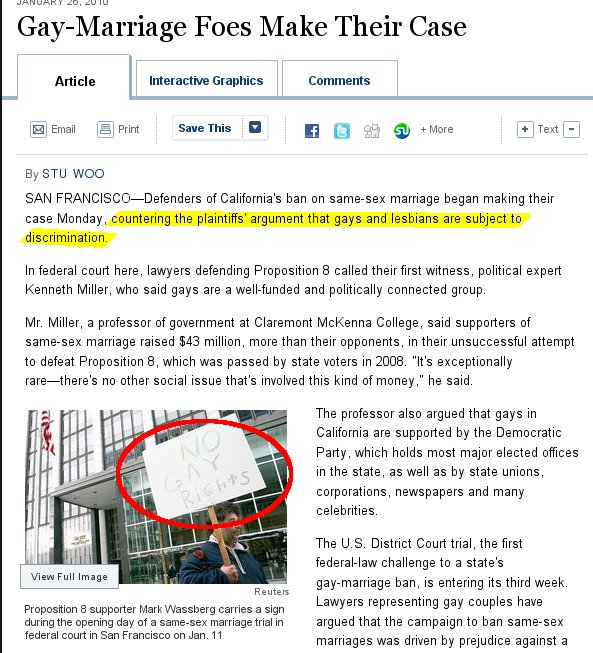
Defenders of California’s ban on same-sex marriage began making their case Monday, countering the plaintiffs’ argument that gays and lesbians are subject to discrimination.

Which is all well and good until you see the photo that ran next to the article:

Prop 8 Discrimination

So this guy is holding up a sign saying “No gay rights”. Right in front of the courthouse in which the lawyers for his side are trying to argue that gays aren’t discriminated against.

I believe that counts as an own goal.

I Loves Me Some Smart Politicians

The Post ran a piece about senator-elect Scott Brown:

His prior visits to Washington, he explained, were mostly to watch his daughter Ayla, a college basketball player, play against American University, or to visit the monuments “as a tourist.”

“I’m a history buff,” he said. “I love the Museum of Natural History.“

*facepalm*

They should have asked him if he thinks a liberal arts college is where students are indoctrinated into the vast left-wing conspiracy.

Or whether he goes shopping on the Mall.